
What Is A Hair Transplant?
A transplant does not create hair. It relocates hair you already have — and that distinction explains almost everything about what the procedure can and cannot do.
A hair transplant moves follicles from a part of the scalp that does not lose hair to a part that has. It is redistribution, not generation. Nothing is added to your head; the total number of follicles you own stays exactly the same.
The reason it works at all is a property called donor dominance. Follicles on the back and sides of the head are genetically insensitive to DHT, the hormone derivative that drives pattern baldness. When those follicles are moved they keep that insensitivity, rather than adopting the fate of the follicles that used to occupy their new location.
That is why transplanted hair is durable. It is also why the hair around it is not: native follicles in the recipient area still carry the sensitivity they always had, and they keep miniaturising on their own schedule. A transplant is not a cure for pattern baldness, and treating it as one is how people end up disappointed at year five.
What gets moved is a follicular unit — a natural cluster of one to four hairs — not an individual strand. Most people average a little over two hairs per unit, which is why graft counts and hair counts are different numbers and why comparing quotes between clinics requires checking which unit is being used.
Modern extraction takes those units out one at a time with a punch under a millimetre across. There is no strip of scalp removed and no linear scar, which is the practical difference between FUE and the older strip technique. What there is instead is a scattering of tiny circular scars across the donor zone, invisible at normal haircut lengths.
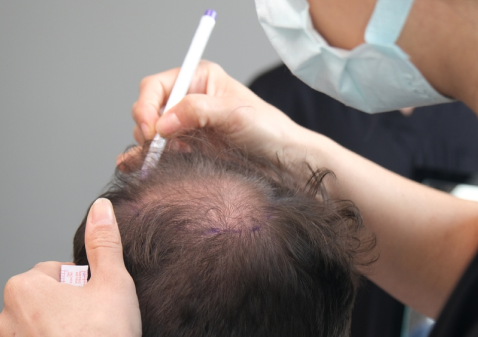
The part that decides whether anyone can tell is not extraction. It is design: where the hairline goes, at what angle each hair is placed, and how density is graded from the leading edge backwards. Those are judgement calls made before a single graft is placed, and they are the reason two technically identical procedures can produce completely different results.
Reviewed by Dr Jawdat Abboud, MD. Educational content — not a diagnosis and not a substitute for examination by a physician. Individual results vary.
Where do you actually stand?
Five visual questions, about two minutes, and a straight read on candidacy.
Comments
3 responses to “What Is A Hair Transplant?”
[…] the process less invasive and improve recovery time. Patients benefit from realistic outcomes, as transplanted hair grows naturally alongside existing strands. Grafting is a trusted option for those seeking […]
[…] unit transplantation (FUT) and follicular unit extraction (FUE) provide permanent solutions by transplanting healthy hair follicles to thinning […]
[…] the other hand, surgical hair restoration, such as hair transplants, involves moving hair follicles from areas of thick growth to thinning or balding areas. This […]