
Defend whatyou still have.
Concentrated from your own blood, injected into the scalp to support follicles that are thinning but not yet gone.
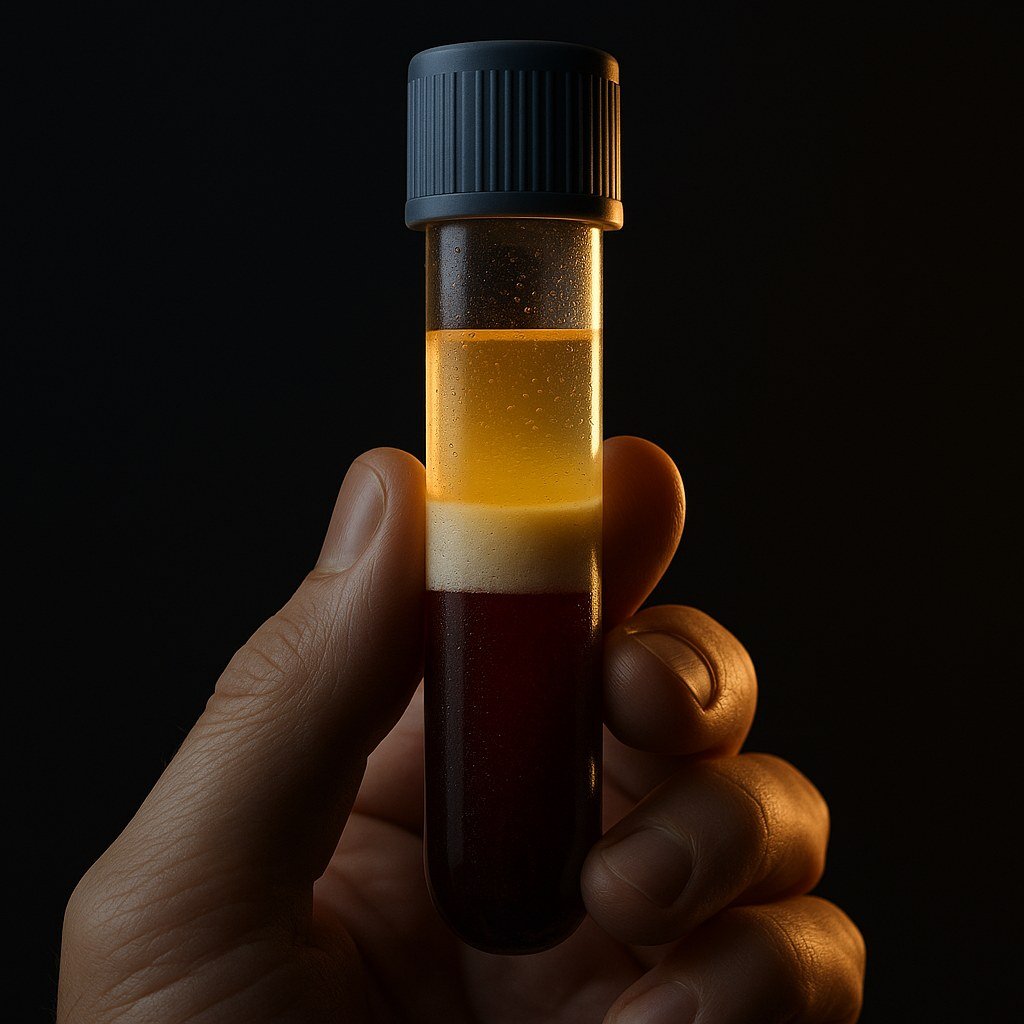
Your own blood, separated.
A small volume of blood is drawn and spun in a centrifuge. The spin separates it by density: red cells settle at the bottom, a thin pale band of platelets forms above them, and straw-coloured plasma sits on top.
That platelet-rich fraction is what gets injected into the thinning areas of the scalp. Platelets carry growth factors, and the working theory is that concentrating them around struggling follicles supports the growth cycle.
Because it comes from you, there is no question of rejection or donor matching.
PRP is not a replacement for surgery.
It will not regrow hair on skin that has been bald for years. Once a follicle is gone it is gone, and no injection brings it back. What PRP can do is support follicles that are still alive but miniaturising.
That makes it useful in two situations: as part of a plan to hold on to native hair, and alongside a transplant to support the surrounding hair that was not moved. If someone offers it to you as an alternative to a transplant for advanced loss, be sceptical.
Good fit
Early to moderate thinning where follicles are miniaturising but still producing hair.
Poor fit
Long-established bald areas with no follicular activity left to support.
Ongoing
Effects are not permanent. Maintaining a benefit means maintaining a schedule.
In and out the same morning.
Draw
A standard blood draw, the same as any lab test.
Spin
The sample is centrifuged to separate the platelet-rich fraction.
Inject
A series of small injections across the thinning areas of the scalp.
Expect scalp tenderness for a day or so afterwards. Individual response varies, and PRP is not suitable for everyone — certain blood disorders and medications rule it out. Suitability is decided at consultation.
PRP questions
Find out whether PRP is worth your time.
For some people it is a sensible part of a long-term plan. For others it is money spent on follicles that are already gone. An examination tells you which.