
How many grafts?
The most-asked question in hair restoration, and the one most often answered dishonestly. Here is what the number means, what published ranges look like, and why nobody can tell you yours over the phone.
A graft is not a hair
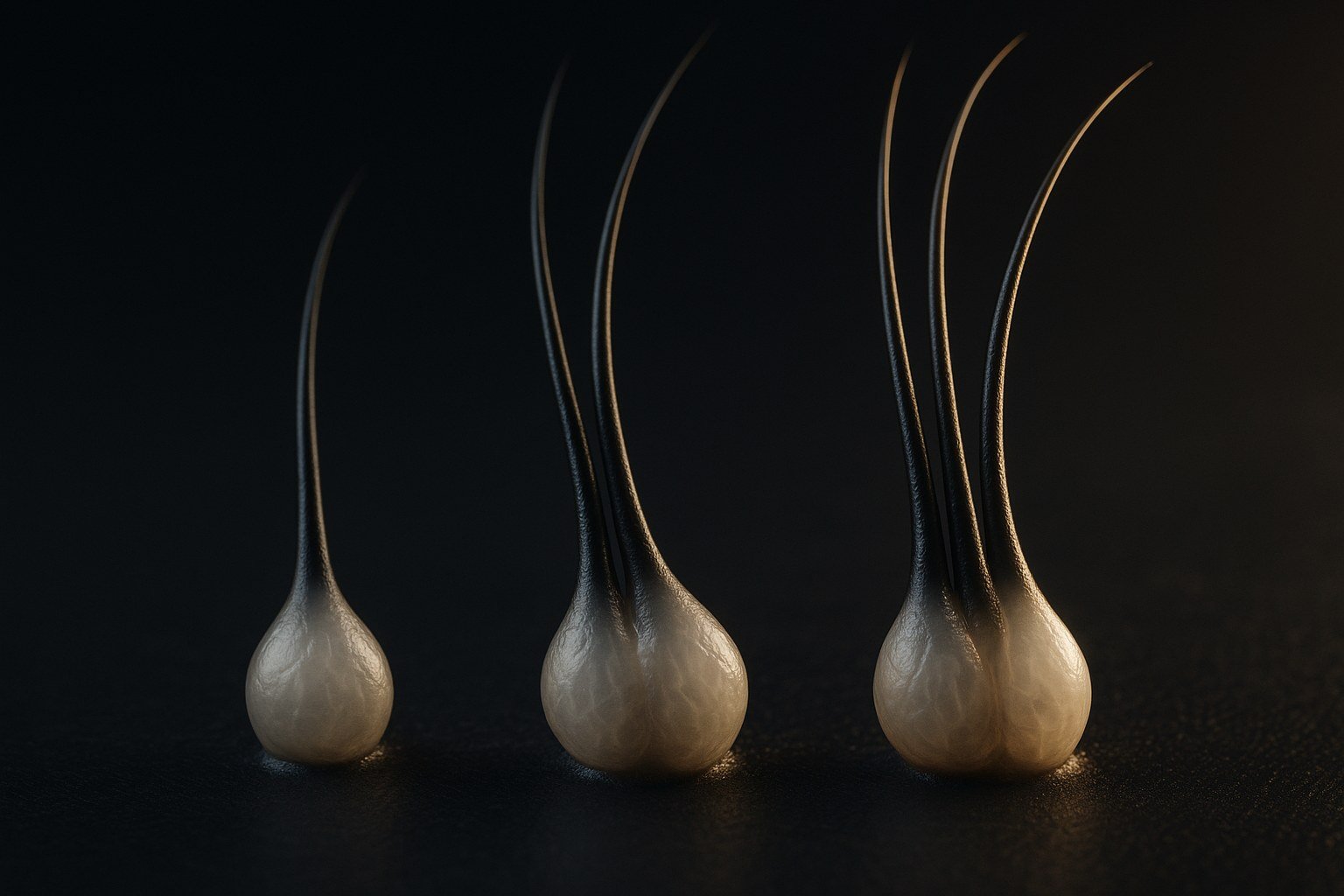
Hair does not grow as isolated strands. It grows in natural clusters called follicular units, each containing one to four hairs, and it is the whole unit that gets moved — intact, with its bulb and sheath.
Most people average a little over two hairs per graft. That is why graft counts and hair counts are different numbers, and why quoting one in place of the other muddies every comparison you try to make between clinics.
How the units are distributed matters as much as the total. Single-hair units belong at the leading edge of the hairline, where a soft, irregular transition is what makes it read as real. Denser two- and three-hair units sit behind, building volume where individual hairs cannot be picked out.
General figures by Norwood stage
These are general published ranges for orientation. They are not a quote, and they are not a statement of what will be performed.
Stage 2
Roughly 800 to 1,500 grafts. Corner refinement rather than restoration.
Stage 3
Roughly 2,000 to 3,000 grafts. Rebuilding a receded frontal hairline.
Stage 4
Roughly 3,000 to 4,000 grafts. Front plus some crown involvement.
Stage 5
Roughly 3,500 to 4,500 grafts, and prioritisation starts to matter.
Stage 6 and 7
Published figures run past what is sensible in one sitting. These cases are staged, prioritised, and sometimes not fully coverable.
Your number
Set after your donor zone is measured under magnification — not from a photograph, and not over the phone.
The number is a budget, not a score
It is tempting to read a high graft count as a better result. It is closer to the opposite: every graft placed today is a graft unavailable in fifteen years, and the donor zone does not refill.
A clinic with an incentive to maximise session size has an incentive to spend your reserve early. The question worth asking is not how many grafts you can get — it is how many are being deliberately held back, and why.
Questions
Sources: ISHRS — Safe Donor Follicle Harvesting in FUE · American Academy of Dermatology
Related
Get a range in two minutes, then get a real number.
The assessment gives you a published range for your stage. An examination gives you yours.